
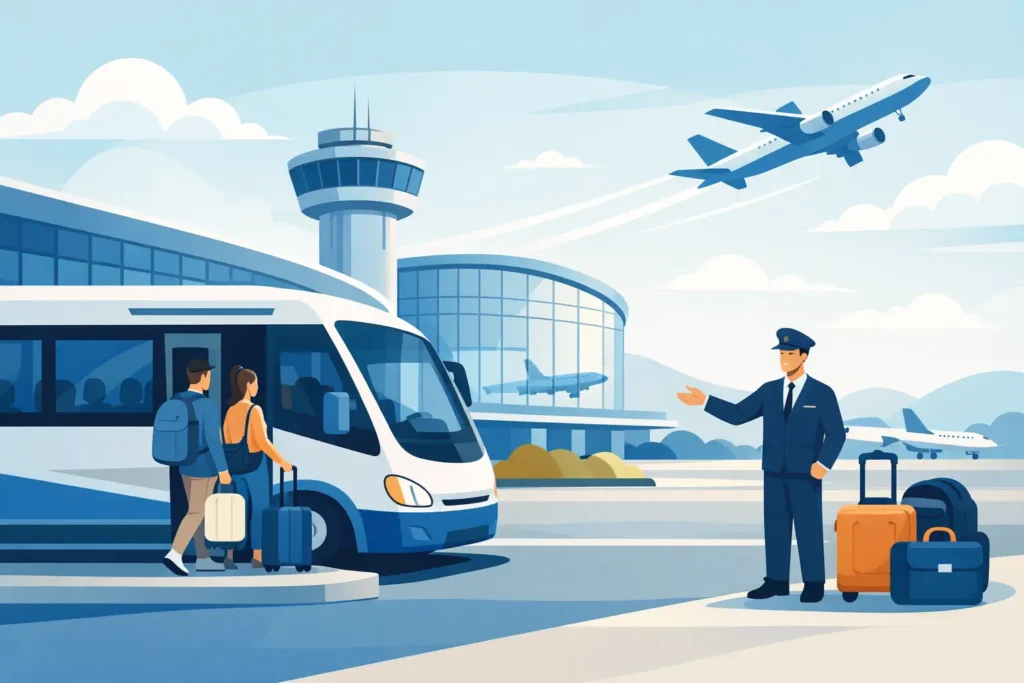
You land after a long flight, collect your bags, and spot signs for hotel shuttle, rental car shuttle, and airport shuttle. At that point, many travelers ask the same question: what does shuttle on airport mean? In simple terms, it usually refers to a shared or scheduled vehicle that moves passengers between the airport and another nearby location, such as a hotel, parking lot, rental car center, or transit hub.
That sounds straightforward, but the details matter. Not every shuttle works the same way, and not every airport ride is the right fit for every traveler. If you are trying to get where you need to go without delay or confusion, it helps to understand what an airport shuttle actually includes, what it does not include, and when a direct taxi or pre-booked ride makes more sense.
When people say shuttle at the airport, they are usually talking about transportation that runs on a route or within a defined service area. The vehicle may circle between terminals, connect passengers to off-site parking, or carry travelers to nearby hotels and rental car facilities.
The key idea is that a shuttle is designed to move multiple passengers efficiently, not necessarily to provide a private door-to-door trip. Some airport shuttles are free because they are operated by the airport, a hotel, or a parking provider. Others charge per passenger and may require a reservation.
In practical terms, a shuttle is built around a system. A taxi or car service is built around your trip.
The word shuttle gets used broadly, so it helps to know the most common meanings.
Large airports often use shuttle buses or train-style shuttles to move passengers between terminals. These are usually free and run frequently. If your connection is in another terminal or your airline check-in is not in the same building, this is often the shuttle you will use.
Many airport-area hotels offer shuttle service for guests. These vehicles usually run on a schedule or on request between the airport and the hotel. Some are complimentary, while others are included in your room rate.
This option can be convenient, but timing matters. If several guests arrive at once, you may need to wait while the shuttle completes another pickup.
Off-site airport parking providers commonly use shuttles to bring customers from the parking lot to the terminal and back again. This is standard at many airports where remote parking is cheaper than on-site parking.
At airports where rental car facilities are not attached to the terminal, a shuttle takes passengers from baggage claim or a designated pickup area to the rental center.
Some companies offer shared airport transportation that picks up multiple travelers going in the same general direction. This type of shuttle may stop at several hotels or neighborhoods before reaching your destination. It can lower the cost, but it usually adds travel time.
Most airport shuttles follow one of two models. They either run continuously on a loop, or they operate on a timed or on-demand pickup system.
A loop shuttle is common for terminals, parking lots, and rental car centers. You go to the designated stop, wait for the next vehicle, and board when it arrives. These tend to be simple and predictable.
A scheduled or on-call shuttle is more common for hotels and private shared ride services. In that case, you may need to call, text, check in at a desk, or reserve ahead of time. The shuttle may not leave immediately, especially if it is waiting for other passengers.
This is where travelers sometimes get caught off guard. Seeing the word shuttle can suggest easy transportation, but the actual wait time, route, and boarding process depend on the provider.
A shuttle is not usually a private vehicle reserved only for you. It also does not always mean direct service from the airport to your final destination.
That distinction matters if you are traveling with children, carrying a lot of luggage, arriving late at night, or working on a tight schedule. A shuttle may be cost-effective, but it can involve waiting, shared seating, multiple stops, or limited operating hours.
For some travelers, that trade-off is perfectly acceptable. For others, it creates unnecessary stress.
The biggest difference is flexibility.
A shuttle generally follows a route, schedule, or service pattern set by the operator. A taxi is arranged around your destination and timing. With a taxi, you do not need to wait for a full vehicle, stop at several other properties, or figure out whether your hotel is within the shuttle zone.
A shuttle can be a good option if you are going to a nearby hotel and do not mind a short wait. A taxi is often the better choice when you want direct transportation, especially if your trip starts early, ends late, or involves a location outside the standard airport shuttle path.
This is especially true in regions where destinations are spread out. In areas like Muskoka, direct transportation matters because travelers are often heading beyond one compact airport district. A professional local provider such as Muskoka Taxi is often the more practical option when your destination is not served by a standard shuttle route or when accessibility and timing are non-negotiable.
Sometimes, yes. Sometimes, no.
If the shuttle is free through a hotel or parking provider, it is obviously the lowest-cost option. Shared ride shuttles can also reduce the price compared with a private ride. But lower upfront cost does not always mean better overall value.
If you have to wait 30 to 45 minutes, make multiple stops, and still walk from a hotel drop-off area with luggage, the convenience cost is real. If you are traveling as a family or group, a private taxi or van may actually be more economical than paying several individual shuttle fares.
Price also depends on distance. Airport shuttles are often most cost-effective for short, common routes. The farther and more specific your destination, the more likely a direct ride will be the better fit.
For arriving passengers, it usually means there is a designated pickup point outside baggage claim or ground transportation. Airports often post signs showing where each shuttle type stops. Hotel shuttles may use one area, rental car shuttles another, and parking buses another.
The main thing to watch is whether you need to take action before boarding. Some shuttles allow walk-up service, while others require you to call the provider after landing. If you assume the shuttle is automatic and it is not, you can lose time quickly.
If your travel plans are simple and flexible, that may not be a problem. If you need certainty, pre-arranged direct transportation is usually easier.
A shuttle is often a good fit when your destination is close to the airport, the service is free or clearly scheduled, and you are comfortable with some waiting. It also works well when you are traveling light and do not need specialized assistance.
For example, a hotel guest staying one night near the airport may do just fine with the hotel shuttle. The same goes for a traveler picking up a rental car at an off-site center.
A direct ride is usually the better choice when time matters, comfort matters, or your needs are more specific than a shuttle route can handle.
That includes late-night arrivals, early departures, business travel, medical appointments, family travel with extra bags, and any trip involving mobility support. It also applies when you are heading to a residential address, event venue, or regional destination that is not part of standard airport circulation.
Accessibility is another major factor. Not every shuttle is equipped or staffed to handle passengers with mobility devices comfortably. If you need a wheelchair-accessible vehicle or trained assistance, it is smart to confirm those details in advance rather than assuming the airport shuttle can accommodate you.
If you want the simplest definition of what does shuttle on airport mean, here it is: it is transportation that helps move passengers to and from airport-related locations, usually on a shared or scheduled basis.
That can be useful, affordable, and completely adequate for the right trip. But it is not the same as personalized transportation. The moment your schedule is tight, your destination is specific, or your comfort needs are higher, a direct service becomes the more dependable option.
The best airport transportation is the one that matches the way you actually travel, not just the sign you happen to see outside the terminal.